Gaming · category guide
Gaming gift cards with crypto: where the money leaks
Gaming is Bitrefill's most active category and its most inconsistent. In-game currency often prices near par; region-locked storefront wallets carried double-digit premiums when we checked. Same category, very different value.
CEX.IO Limited is authorised and regulated by the Gibraltar Financial Services Commission as a DLT Provider (authorisation FSC0686FSA) and is a FinCEN-registered Money Services Business in the United States.
The quick verdict
Gaming is where Bitrefill sees the most traffic and where the value varies most wildly. Two rules cover almost everything:
- In-game currency and app-store balance — Robux, Free Fire Diamonds, App Store credit — tends to price at or near face value.
- Region-locked storefront wallets — Steam, PlayStation, Xbox — carry the premiums. Steam measured +10.6% at $50 and +13.7% at $200.
If you are flexible about how you fund your gaming, that difference is real money. If you need Steam credit specifically, you are paying for it — check a second platform first, and read the Steam page for the numbers.
What is actually available
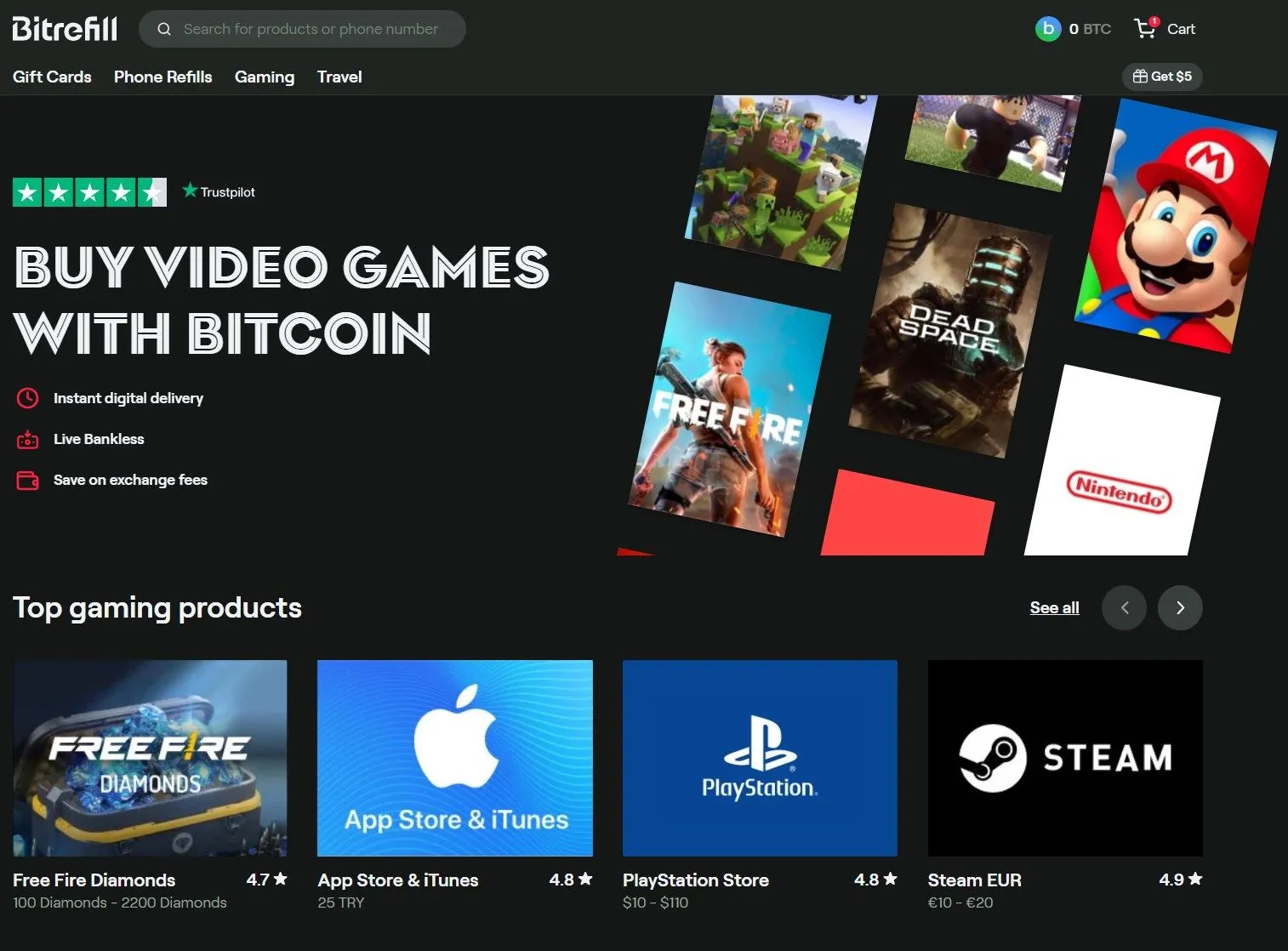
Bitrefill's gaming page led with Free Fire Diamonds, App Store & iTunes, PlayStation Store and Steam when we captured it. Behind those sit the platforms and titles you would expect.
Pricing across the category
We measured what we could and the spread inside a single category was wider than we expected. These are observed figures, not estimates, and gift card pricing is live data — verify before you buy.
Swipe sideways to see every column.
| Product type | Typical pricing | Why |
|---|---|---|
| In-game currency Robux, Diamonds, Riot Points | At or near face value | Publishers want the currency circulating; distribution is subsidised |
| App-store balance Apple, Google Play | At or near face value | Price-checked reflexively by customers; thin margin either way |
| Console storefront PSN, Xbox, Nintendo | Slight premium typical | Regional pricing to protect; codes move at close to face |
| Steam wallet | +10.6% to +13.7% observed | Heavy regional arbitrage pressure; premium grows with denomination |
Region rules, platform by platform
Gaming has the most aggressive geo-locking of any category, because every major platform prices content regionally and depends on codes not crossing borders.
PlayStation and Xbox lock to the console account's country. A US PSN card requires a US PSN account, full stop. Both platforms also make changing account country awkward, and on PlayStation it historically meant creating a new account and losing access to purchases on the old one.
Steam locks to the account region setting, which Bitrefill states plainly on the product page: a USD card is valid only for accounts with the USA selected as the region.
Nintendo eShop locks to account country, and Nintendo balance is famously non-transferable between regions.
Roblox and in-game currency are the loose end, in a good way. Because these products credit a player account or ID rather than a regional storefront wallet, they tend to be more forgiving — though you should still read the currency on the product rather than assuming.
In-game currency versus wallet credit
This distinction decides both your price and your flexibility, and most guides do not draw it.
Wallet credit — Steam funds, PSN balance, eShop credit — is general-purpose money inside one storefront. It buys anything on that platform, which is exactly why it carries a premium: you are paying for optionality, and optionality is what regional arbitrageurs want.
In-game currency — Robux, Free Fire Diamonds, Riot Points — is specific. It buys one game's content, it usually credits directly against a player identity rather than a storefront region, and publishers actively want it in circulation because it drives engagement. So it is subsidised into distribution and tends to price at par.
The practical implication: if you know what you want, buy the specific thing. Someone who wants Robux should buy a Roblox product, not Steam funds. Someone who wants one particular game may be better off buying it directly than funding a wallet at a 13% premium to do so. The premium is the price of not having decided yet, and it is genuinely expensive on some brands.
Reading the per-product ratings properly
Bitrefill shows a star rating on individual products, and it is the most underused piece of information on the site. On the gaming page we captured, Steam EUR showed 4.9, PlayStation Store and App Store & iTunes 4.8, and Free Fire Diamonds 4.7.
Those numbers are more informative than the overall 4.6/5 Trustpilot score, because they are SKU-specific. Delivery problems in this business are rarely platform-wide — they are supply-chain problems affecting one product line, and they accumulate visible complaints on that product fast. A high rating across a meaningful number of reviews tells you that specific code type has been arriving and working.
What the rating does not tell you is whether the price is fair. Steam rated 4.9 while carrying the biggest premium we measured, because the rating reflects delivery reliability rather than value. Read the rating for "will this work?" and do the division for "should I pay this?". Two different questions, two different checks.
The spending-control case, which is genuinely strong
Set aside crypto for a moment. The best reason to buy gaming credit as a fixed-value code has nothing to do with how you paid, and it is the argument we would make to someone sceptical of the whole category.
Modern free-to-play games are engineered around impulse purchases: low friction, stored payment methods, currency bundles priced to leave awkward remainders. A gift card breaks that machinery. A code cannot overspend, cannot auto-renew, and cannot be charged twice. When it runs out, it runs out.
That makes it the right instrument for funding a younger player's account without attaching a card to it, and a reasonable discipline device for anyone who has been surprised by a games bill. Add that buying it needs no identity documents inside Bitrefill's unverified limits — $500 a day per the KYC page — and you have a clean, capped, low-friction way to fund gaming that a debit card simply cannot match.
Just do the division first. Paying 13% over face value for the privilege of a spending cap undercuts the point. The fees page has the full picture, and the redemption guide covers getting the code safely onto the right account.
Frequently asked questions
What gaming gift cards does Bitrefill sell?
The featured set on its gaming page when we captured it was Free Fire Diamonds, App Store & iTunes, PlayStation Store and Steam, with Roblox, Xbox, Nintendo, Minecraft and Valorant among the wider catalogue. In-game currency, storefront wallet credit and platform subscriptions are all covered.
Which gaming cards are cheapest on Bitrefill?
In-game currency and app-store balance tend to sit closer to face value than region-locked storefront wallets. Steam was the clear outlier when we measured — +10.6% at $50 and +13.7% at $200. Divide the listed price by the face value on whatever you are about to buy; the spread within this one category is wide.
Can I buy Robux with crypto?
Yes. Bitrefill sells Roblox gift cards, which credit Robux or Roblox credit depending on the product. Redemption is at roblox.com/redeem, and Roblox products are typically less rigid about region than PlayStation or Steam — though you should still read the currency on the product.
Do PlayStation and Xbox cards work in any region?
No. Both are locked to the console account's country. A US PlayStation Store card requires a US PSN account; the same applies to Xbox. These are among the strictest locks in gaming because both platforms price content regionally.
Is Free Fire Diamonds available with crypto?
Yes — it was the first featured product on Bitrefill's gaming page when we looked, offered across a range from 100 to 2,200 Diamonds and rated 4.7/5. In-game currency products like this usually credit against your player ID rather than needing a storefront account region to match.
Why are gaming gift cards marked up more than Amazon?
Distribution economics. Amazon uses gift cards to acquire customers and sells them into distribution at a genuine discount. Game storefronts already have the players, so their codes move at close to face value — leaving a reseller only one way to profit. Regional price arbitrage adds further pressure on storefront wallet codes specifically.
Are the per-product ratings on Bitrefill useful?
Yes, and they are underused. A specific SKU with delivery problems accumulates visible complaints fast, so a high rating across many reviews is real signal about that product rather than about Bitrefill generally. On the page we captured, Steam showed 4.9, PlayStation Store and App Store 4.8, and Free Fire Diamonds 4.7 — all beneath an overall Trustpilot score of 4.6/5.
Is buying game credit with crypto good for controlling spending?
It is one of the best arguments for the whole category. A fixed-value code cannot overspend, cannot auto-renew and cannot be charged twice — which matters enormously for free-to-play games designed around impulse purchases, and for anyone funding a younger player's account without attaching a card to it.
Sources and further reading
Updated: August 12, 2026 · Independent editorial — we are not Bitrefill.